Is It Still Safe to Travel to Los Cabos in 2026? What Visitors and Investors Should Know

Is It Still Safe to Travel to Los Cabos in 2026? What Visitors and Investors Should Know
Safety in Los Cabos: Looking Beyond Headlines
When travelers consider visiting Mexico, safety is often the first question that comes to mind. News coverage sometimes highlights isolated incidents in different parts of the country, creating the impression that security conditions are uniform nationwide. In reality, Mexico is a large and diverse country where safety levels vary significantly by region.

Destinations such as Los Cabos, located at the southern tip of the Baja California Peninsula, operate under a very different economic and security model than many inland cities. The region’s economy depends heavily on tourism, luxury hospitality, and international real estate investment, which has led to long-term efforts by both public and private sectors to maintain a safe environment for visitors.
As a result, the resort cities of Cabo San Lucas and San José del Cabo consistently rank among the most visited destinations in the country.
Geography Plays a Major Role in Security
One of the structural advantages Los Cabos has is its geographic isolation.
Unlike major metropolitan areas connected by extensive highway networks, Los Cabos sits at the end of a peninsula surrounded by ocean on three sides. This geography significantly limits land access points and makes monitoring entry routes easier for authorities.
Because the destination relies so heavily on tourism, security resources tend to be concentrated in the main resort areas, including:
- the Tourist Corridor
- the Marina Cabo San Lucas
the historic district of San José del Cabo

Many residential communities and resorts also operate private security systems and controlled access, adding an additional layer of safety for residents and visitors.
Safety Perception Compared to the National Average
According to data from INEGI (Mexico’s National Institute of Statistics), safety perception varies widely across the country. While large urban centers often report higher levels of concern, smaller tourism-focused destinations frequently show stronger safety perception among residents and visitors.
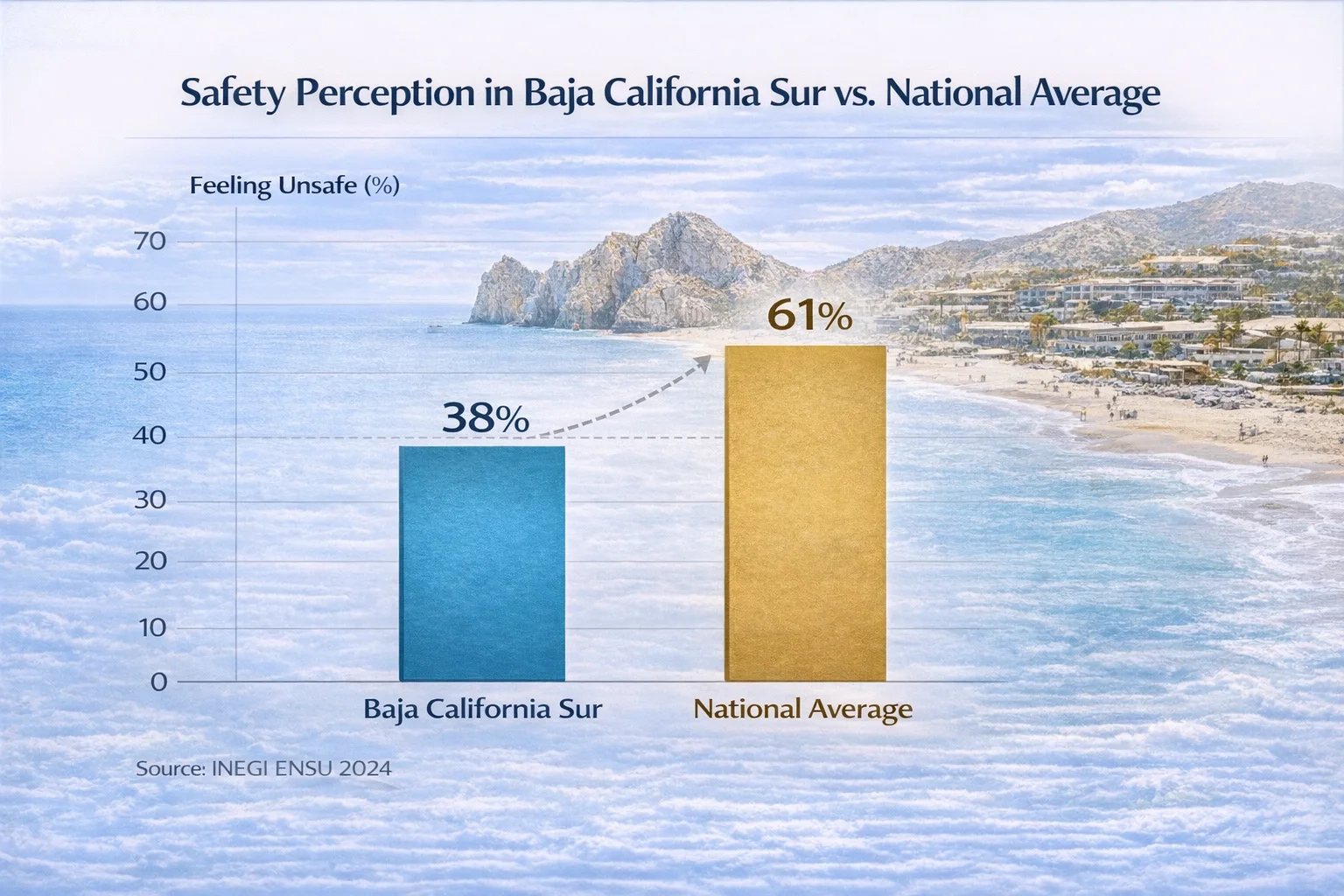
Additionally, tourism surveys regularly show that over 90% of visitors report feeling safe during their stay in Los Cabos, according to local tourism monitoring reports.
Millions of Visitors Each Year with Minimal Incidents
Another way to evaluate safety is by looking at visitor volume relative to reported incidents.
According to the Los Cabos Tourism Observatory, the destination welcomes more than 3.7 million visitors annually. The vast majority of those travelers experience the destination without safety issues, spending their time enjoying beaches, restaurants, outdoor activities, and nightlife.
Popular areas like Playa El Médano remain active tourism hubs year-round, with beach clubs, water sports, and restaurants operating daily.
When viewed in the context of millions of annual visitors, reported incidents affecting tourists remain extremely rare.
Recent Events in Other Cities Highlight Regional Differences
Occasionally, security events in other Mexican cities create broader headlines about safety in the country. For example, recent incidents reported in Guadalajara circulated widely on social media and international news outlets.
However, these events occurred more than 1,000 kilometers away from Los Cabos, in a completely different region of the country with different economic drivers and security conditions.
Local observers in Los Cabos noted that tourism activity continued normally during that time, with restaurants, beaches, and hotels operating as usual.
video: https://www.instagram.com/p/DVHqqQUgfJi/
A video circulating online illustrates the contrast between national headlines and the everyday reality in the destination:
The footage shows normal tourism activity along the Cabo coastline, highlighting how localized incidents elsewhere in the country do not necessarily reflect conditions in Los Cabos.
Strong Tourism Infrastructure Supports Stability
Another factor reinforcing stability in the region is the scale of tourism infrastructure.
Los Cabos is home to:
- more than 18,000 hotel rooms
- dozens of luxury resorts
- internationally recognized golf courses
- private residential communities
This concentration of investment has created strong collaboration between local government, tourism authorities, and the private sector to maintain the destination’s reputation.
Because tourism drives the local economy, maintaining visitor confidence is a top priority.
Why Real Estate Investors Continue Choosing Los Cabos
For real estate investors, safety and stability are critical factors when evaluating international property markets.
Despite occasional headlines about security in other parts of Mexico, Los Cabos continues to attract buyers from the United States, Canada, and increasingly Europe. Many of these investors first visit the destination as tourists before eventually purchasing second homes or vacation properties.
Luxury communities such as Palmilla, Pedregal, and Querencia have become internationally recognized residential destinations, offering security, privacy, and world-class amenities.
These developments often include:
- controlled access
- private security
- property management services
- resort-level infrastructure
For international buyers, this environment provides additional peace of mind when purchasing property abroad.
The Bottom Line
Safety perceptions are often shaped by national headlines, but the reality on the ground can vary dramatically between regions.
In the case of Los Cabos, several structural factors continue to support its reputation as one of Mexico’s safest and most successful tourism destinations:
- geographic isolation on a peninsula
- strong tourism-driven economy
- high visitor satisfaction rates
- large-scale private investment in resorts and residential communities

https://fiturca.com/wp-content/uploads/2026/02/ObservatorioLosCabosdic2025.pdf
For travelers and investors alike, these fundamentals help explain why millions of visitors continue to choose Los Cabos every year—and why many eventually decide to make the destination their second home.
In the case of Baja California Sur, where Los Cabos is located, crime indicators are generally lower than the national average, particularly in areas closely linked to tourism infrastructure.
Categories
Recent Posts









GET MORE INFORMATION